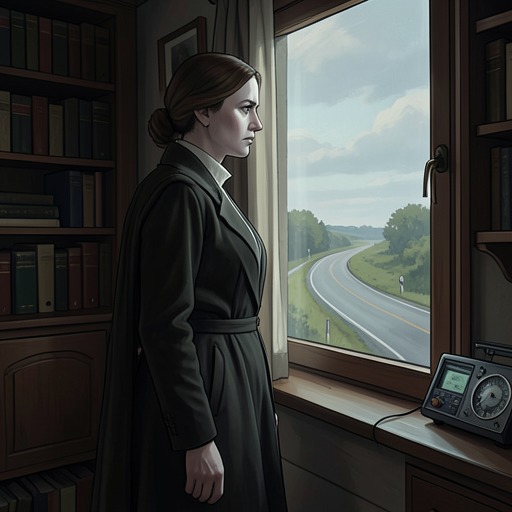
Anne Larsen
Bonjour tristesseAnne Larsen is a divorced couturière whose composure and independence set her apart from the pleasure-seeking household she enters. Once a formative guide to Cécile, she becomes Raymond’s intended wife and the object of Cécile’s increasingly deliberate efforts to disrupt their marriage. Her story moves from quiet authority to a departure Cécile tries to prevent, and finally to a fatal crash whose consequences cannot be managed like the intrigues that preceded it.
Identity and Background
At forty-two, Anne is described as beautiful and much sought after, with a proud, tired face and an air of indifference that can intimidate. Though divorced and free, she is not known to have a lover. She works in couture, while Raymond works in advertising; their professional connection and shared memories of Cécile’s mother have brought them into contact over time. Their social worlds differ sharply. Anne keeps company with discreet, intelligent people, whereas Raymond and Cécile favor louder, more frivolous acquaintances. She appears to look down on their appetite for amusement and excess, but is also described as kind and distant rather than openly hostile.
Anne’s history with Cécile gives their later conflict its intimate force. After Cécile left boarding school, Raymond, embarrassed and unsure how to manage his daughter, sent her to Anne. In a week, Anne dressed her with taste and taught her how to live in the adult world. Cécile developed an intense admiration for her; Anne redirected that attachment toward a young man in her own circle. Cécile remembers Anne as responsible for her first elegance and first love, and feels grateful to her. The relationship therefore begins not as a contest between strangers but as one of admiration and indebtedness.
Marriage and Authority
Anne’s sudden arrival at the villa unsettles Cécile partly because Anne’s views on education conflict with the household’s easygoing habits. The deeper disruption comes when Anne tells Cécile that she and Raymond intend to marry. Cécile waits for Raymond to signal that the announcement is a joke, but he looks down at his hands; she understands that the marriage is real even as she offers a polite response to gain time.
Anne soon asserts a responsibility toward Cécile that the younger woman resents. After learning of Cécile’s involvement with Cyril, Anne tells her not to see him again: Cécile is seventeen, Anne considers herself partly responsible for her, and she will not let the girl ruin her life. She also insists that Cécile has work to do in the afternoons. Anne turns away without inviting negotiation. To Cécile, this is not merely a rule but a denial of her accustomed freedom and of her identity as someone Anne has known for years. The directive makes Anne’s prospective place in the family concrete: she intends to intervene, not simply to occupy the role of Raymond’s companion.
Yet Anne’s authority is not presented as a simple absence of tenderness. Cécile observes her concern, her kindness, and the attentive look she sometimes gives her. In one charged moment, Anne watches Cécile struggle to light a cigarette with trembling hands. After the match repeatedly fails and Cécile drops the box, Anne lifts her face, then lets her go without asking a question and places a lit cigarette in her mouth. Cécile later tries to give this small, unspoken gesture a symbolic meaning, but cannot settle on one. The episode preserves Anne’s capacity for care while leaving its meaning unresolved.
Cécile’s Intrigue and the Family Triangle
Cécile recruits Elsa Mackenbourg by presenting Anne as an adversary who has used domestic morality and the promise of a balanced household to win Raymond. She tells Elsa that the marriage will destroy all three of their lives and asks her to help protect Raymond, whom she portrays as childlike. The appeal is calculated, but it also expresses Cécile’s genuine fear that marriage will replace the freedom she and her father share with a more ordered life. She simultaneously sees herself as defending Raymond and recognizes, in private, the ferocity of her wish to separate him from Anne.
Cécile’s manipulation depends on shifting loyalties among four people. She arranges for Elsa and Cyril to appear together, hoping to rekindle Raymond’s desire for Elsa and weaken his commitment to Anne. Raymond and Cécile encounter the pair asleep together in the pine wood; Raymond turns away without waking them. Cécile understands how well she can direct her father’s thoughts, and his response confirms that the staged image can intensify his possessiveness. Anne, meanwhile, becomes the person whose marriage is at risk, although Cécile’s scheme relies on concealing its real purpose from her.
The arrangement does not leave Cécile untouched. She continues to see Cyril secretly, while encouraging Raymond’s attraction to Elsa and allowing Anne to believe that the household’s future remains intact. Looking back, Cécile describes the period as one of duplicity and inner silence. Anne’s laughter and kindness become sources of guilt that Cécile tries to escape through distractions such as smoking, playing a record, or calling a friend. The narrator’s account makes clear that Anne is not merely an obstacle in Cécile’s plan: she is also the person whose ordinary warmth makes the plan harder for Cécile to justify to herself.
Departure and Fatal Accident
Anne eventually appears running from the wood, awkward and hurried, and disappears around the house toward the garage. Cécile realizes what is happening and runs after her, reaching the car as Anne starts it. Cécile tries to stop her at the door, admits that the situation is her fault, and promises an explanation. The attempt comes at the point when Anne has already decided to leave; the available account does not establish what Anne has learned or what answer she gives before driving away.
At ten that night, a telephone call initially gives Raymond and Cécile hope that Anne is calling to forgive them and return. Raymond answers eagerly, but his replies become faint as he receives the news. Anne has had an accident on the Estérel Mountain Road. The caller explains that it took time to find her address, reaching the household’s number through Paris, and that the car fell fifty meters at a particularly dangerous location where many accidents had occurred. Raymond says it would have been miraculous for her to survive. Anne’s departure thus ends not in a reconciliation or a new household arrangement but in a fatal accident, making Cécile’s earlier confidence in her ability to steer other people’s feelings tragically inadequate.
Narrative Role and Significance
Anne is both a person in Cécile’s remembered past and the measure against which Cécile examines her own motives. She once gave Cécile elegance, guidance, and a first experience of love; later, she represents education, restraint, and the possibility of a lasting family structure. Cécile’s resistance to those qualities is sharpened by the fact that she admires Anne and remains conscious of what she owes her. Her authority can feel cold to Cécile, but her gestures also show attentiveness that cannot be reduced to control.
Because Anne’s inner life is largely seen through Cécile’s retrospective narration, the novel leaves a gap between her composed exterior and the feelings others imagine for her. Cécile wonders whether Anne envies Elsa, interprets her looks, and tries to infer what she knows, but those conjectures do not become direct access to Anne’s thoughts. That distance matters: the plot’s emotional triangle is shaped by Cécile’s interpretations as much as by Anne’s actions. The cigarette scene briefly suspends the contest, replacing interrogation with a practical act of care, while the accident finally exposes the limits of Cécile’s schemes. Anne’s significance lies in this tension between the self-command Cécile fears and the human vulnerability she only partly recognizes.